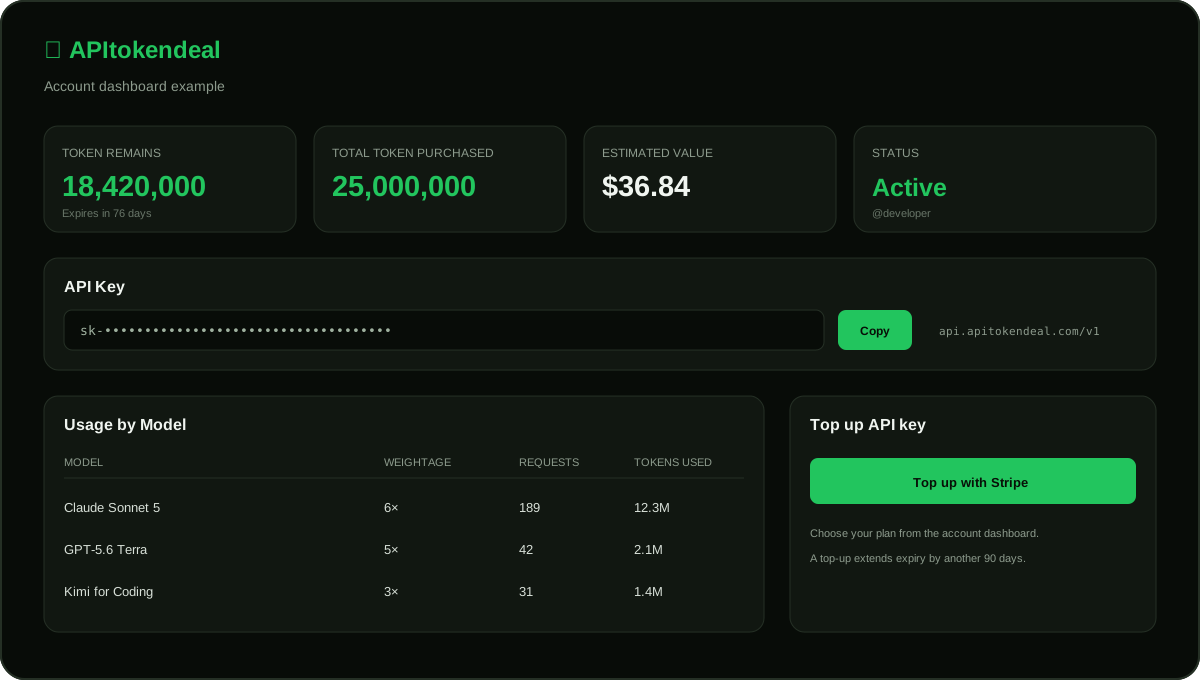
Token packs turn model usage into a visible prepaid balance.
Buy API Token Packs upfront, use one API key across supported models, and track usage from your account dashboard.
Token packs turn model usage into a visible prepaid balance.
Instead of signing up for a postpaid account with each AI provider and receiving a monthly invoice for whatever you consumed, APItokendeal uses a prepaid token model. You buy an Explorer, Starter, or Pro token pack and load the tokens into your account. Every API request you make deducts from that balance based on the model you use. When the balance runs low, you top up. There are no month-end surprises, no unexpected bills, and no complicated usage allocation across projects.
This model is particularly well suited for teams that use coding agents, run automated workflows, or build applications on top of AI APIs. These workloads tend to have variable usage patterns that are hard to predict in advance. A prepaid balance creates a natural budget boundary without requiring you to estimate your exact monthly consumption.
Not every model consumes tokens at the same rate. A lightweight model like MiniMax M3 burns one token per token of usage. A premium model like Claude Opus 4.8 can burn twenty tokens per token of usage. This system, called model weightage, reflects the relative cost of running each model. A 1× model costs one unit per token. A 20× model costs twenty units per token.
Weightage is not a hidden fee — it is a transparent way to show that different models have different operating costs. When you check the model catalog, every supported model lists its weightage alongside its name and model ID. You can calculate how many usable tokens a given pack gives you on the models you actually use. For example, the Pro pack at 100 million tokens gives you 100 million tokens of usage on 1× models, or 5 million tokens of usage on a 20× model like Claude Opus.
This transparency lets you make informed decisions about model selection. If you are iterating on code rapidly, you can use a cheap model for the bulk of your work and reserve expensive models for the final review where their capability adds the most value.
The most effective way to reduce your token spend is to use the right model for each task. A typical workflow might involve 90% routine coding and iteration, and 10% complex reasoning and review. If you run everything on a premium model, you pay premium rates for all of it. If you use a lightweight model for the routine work and a premium model only for the critical tasks, your effective cost drops significantly.
Consider a project that uses 10 million input tokens and 1 million output tokens. Running everything on GPT-5.5 at official rates would cost around $80. Using MiniMax M3 for 90% of the work and GPT-5.5 for the final 10% reduces the same workload to about $15.56 at official model prices — a savings of roughly 80%. Actual savings depend on your specific model mix, caching, and usage patterns, but the principle holds across providers: model blending is the most powerful lever you have for controlling costs.
Each token pack has a 90-day expiry from the date of purchase. However, every time you top up, the expiry of your entire balance — including both existing and new tokens — extends by another 90 days. This means your tokens do not expire as long as you remain active. If you use the API regularly, your balance stays current. If you pause usage, you have up to 90 days from your last top-up to resume before the balance expires.
You can check your remaining balance, model-level consumption, and request history at any time from your account dashboard. The dashboard updates in real time, so you always know where your usage stands before making your next top-up decision.
Use APItokendeal to manage AI API usage with one dashboard and one managed access layer.